We all have our pet projects where we like to think that things should stay the same and would be most upset should they change. Unfortunately change is the reason why we are the dominant species on the planet. If it wasn’t for change then we probably would still be leading lives of short terror as some form of hominoid in the African rift valley. In short we all must embrace change and make the best of things.
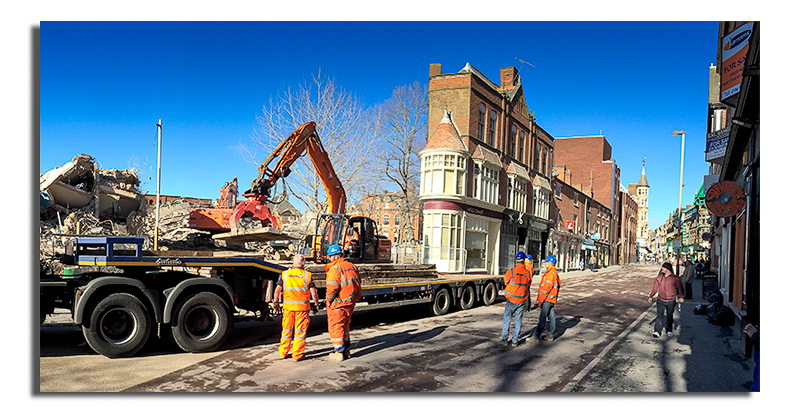
This thought came through my mind as I was wondering around Leicester city centre this morning. On my travels took me past the site of the previous City Council offices that were demolished on Sunday. The buildings were unloved but they had been a landmark in the city since the 1970’s – now they are no more.
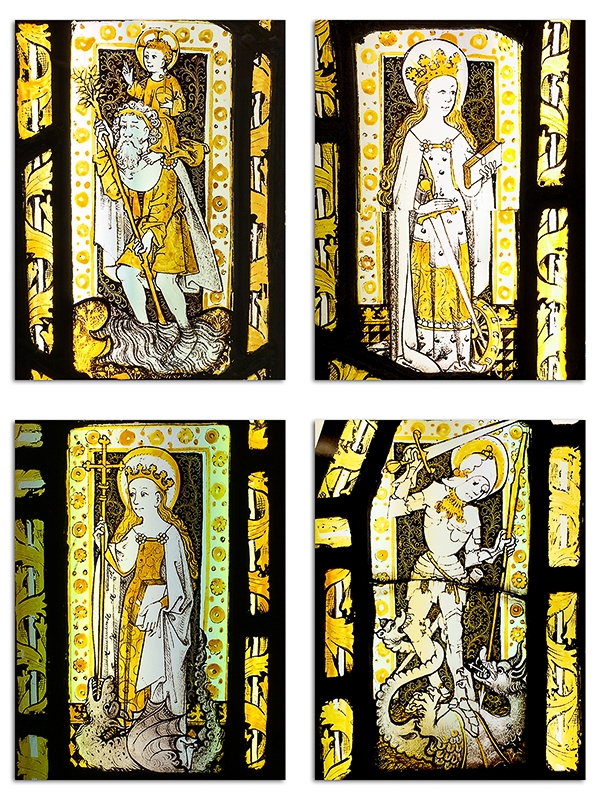
As I roamed the city centre I took in the Newark Houses museum where I found these delightful late medieval stained glass windows. They date from around 1500 AD and clearly depict a vibrant Catholic England. However, within the life of the former City Council office block all this iconography was brushed away and the English reformation was forced on the reluctant English by their King’s Henry and Edward. Some changes are minor and some are not but we all have to make the most of the cards that life deals us. As the Borg would say “Resistance is futile”.

Better late than never I guess. Anyway both volumes are now available at Blurb should you wish to view. The links are below:
Volume 8
http://www.blurb.co.uk/bookstore/invited/5428991/c293c5970031b2be505e3565d0d36ecdd1390c60
Volume 9
http://www.blurb.co.uk/bookstore/invited/5428980/d2c8836d3cf7aa1d89c1e022181d43eaa72aac68

If you ever have the opportunity to see Rembrandt’s portraits in close proximity you will notice that many of them, whilst formally being of someone else, end up having a strange resemblance to the great man himself. I don’t believe that this is a particularly new revelation but as with many things Rembrandt it always come back to the nose.
This morning in my art class we had to chose a portrait to copy/work on and I choose a portrait from Rembrandt’s later period and after around two hours work this was the result. This is little more than the first stab at the painting but I think it is travelling in the correct direction – there is an awful long way for it to go before it would be considered finished. However, art classes have time limits and this was the best I could do in the time.
Over the weekend there has been a series of articles by political commentators about the likely make up of the next government. The SNP boggy man (or should that be woman?) card was played heavily as though Scottish voters were second class citizens. It seems that many people find it a unpleasant thought that a political party should act in its own interest i.e Scotland’s interest as they see it, rather than the United Kingdom’s. Equally, many scare stories were being given another run out about the perils of another coalition government, its formation and it’s fragility. It was even hinted that a government not formed by the party with the largest number of MP’s might in some ways not be legitimate or that such a government might be the government that nobody voted for. This is nonsense.
In the first past the post constituency parliamentary system we have people don’t vote for a government they vote for their local MP. The local MP then joins with other MP’s to help form a government however, he or she is first and foremost an MP rather than a member of the government and so if he or she wish to work with other MPs to form a different government then they are welcomed to do so. This, of course, is a hugely simplistic model of how the House of Commons works but at its core lies the problem faced by all major parties who wish to try and form a government. Governments depend on being able to pass their legislation through parliament, which in turn requires discipline amongst their party’s MPs. However, with the fixed term parliament and the rise of smaller political parties, which the SNP must be considered as, party discipline starts to break down and suddenly we are faced with the prospect of Governments falling on a regular basis. This is seen by the traditionalists as an attack at the heart of the way that the country is run. Whether this is the case remains to be seen.
What it does mean is that business as usual is not the way forward. It will mean that fewer laws will be passed, not a bad thing in this author’s view, and perhaps more time will be spent holding the Government of the day to account for what they want to do. It will be messy and not to everyone’s liking, especially the rump ‘major’ political parties who will have to form differing coalitions to get their legislation through. The irony of all this is that should some form of proportional representation become the method by which MPs are elected then it can rightly be claimed that the voter is voting for a party. But of course this would then lead to coalition governments being the norm and Britain may well start entering the twenty first century rather than still think along the lines of twentieth century. Wouldn’t that be refreshing?
Simon Marchini
http://www.simonmarchini.co.uk

The speed of light is a constant, well in most of the universe but in the quantum level things aren’t that straight forward. Time is also supposed to be a constant, travelling in one direction and a constant pace. However, anyone who is getting older will tell you that time is not a constant but rather seems to quicken just as the body starts its slow decline. Maybe that is another universal constant the inverse ratio of time and your age, so as a youngster time seems to stand still but around forty things seem to start to change and now time is disappearing at an alarming rate.
So it is with this project..it seems like yesterday that I sat in the cafe at Tate Liverpool and came up with this idea now it is 12 months later and I only have 60 or so days to go. What will I do with my life then?

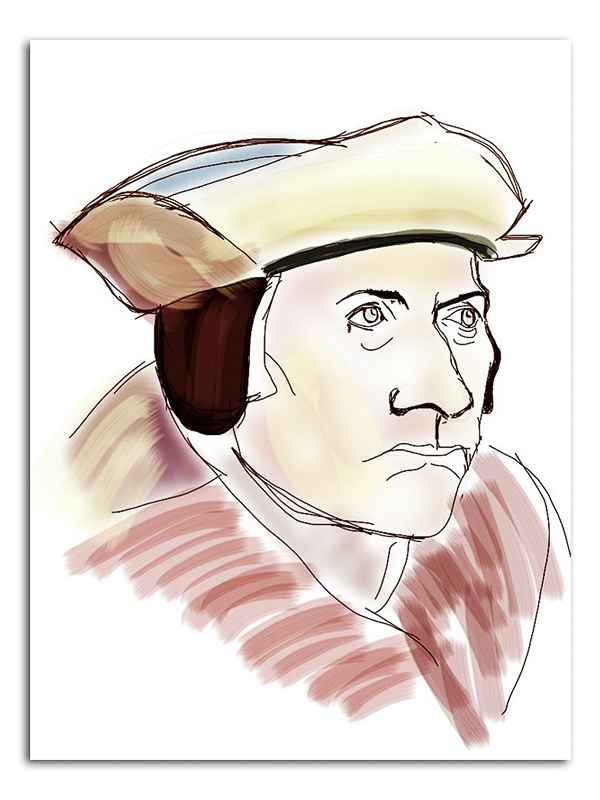
I, like many people, have been enjoying the series Wolf Hall. For those of you who are not aware it is the story of Thomas Cromwell, Henry the Eighth’s most notorious political advisor, as told by Hilary Mantel in her novel of the same name. As I was watching the series o it struck me that I have already made a painting of Cromwell nearly 3 years ago and so I decided to make a quick drawing of the wonderful Mark Rylance as Cromwell. It is strange how these things keep recurring in one’s life – actually it is not as you might be aware I am interested in history, politics and political dramas so I guess it isn’t that strange after all.
BTW I think the brushes portrait may have been of one of Henry’s courtiers rather than Cromwell – such is fun one’s memory plays one one.


I cannot say I know a great deal about Ernst Haas other than a book of his photographs had a great influence back on me in the 1970’s. (I have just discovered that the book was called The Creation and I seem to remember that it came as a free gift if I subscribed to the long defunct Camera magazine, although I don’t believe it was the limited edition version!) I was reminded of this when I was going through Pinterest today and I came across one of his photographs. As soon as I saw it my memories of the almost forty years ago came flooding back. It is so amazing how the slightest impulse through the brain reignites connections that had stayed dormant for all those years. In honour of those memories I have just made these Haas ‘ish’ images from my recent holiday in Florida.

Tate Britain is the national gallery of British art from 1500 to the present day
If Wikipedia is correct, a question you should always ask about any entry in that wonderful collection of human history and nonsense, then why hasn’t the Tate purchased at least one piece of Jack Vettriano’s work? This is not an argument over whether Vettriano’s is a good or great painter, I think down in the good end of this spectrum. No it is about art history and ensuring the record is complete for future generations. I am sure there are many British artists who don’t have work in the august body’s collection but whether you like him or not Vettriano is a very successful British artist and so should be there.
Here, I think, is the rub of it all. Vettriano is too successful for his own good. If he had stayed some jobbing artist and not become a millionaire on the back of his work then you wouldn’t be reading this. But he is successful and this rubs the nose of the many ‘important’ artists and their supporters. Here is some up start from a Scottish pit village producing quite ordinary works of art selling for outstanding amounts of money how can that be fair? The art world is nothing if not jealous about other people’s success. So in a fit of pique the art establishment appears to have decided to turn their backs on him. Even in his native Scotland he all but despised in the art establishment.
One day the bottom may fall out of the Jack Vettriano art market and if that should happen I am sure there will be many members of the art establishment who will be overjoyed. However, in a hundred years time when some art historian is trying to find his work he will not be able to look in the National Gallery of British Art’s collection. This is wrong and should be corrected.
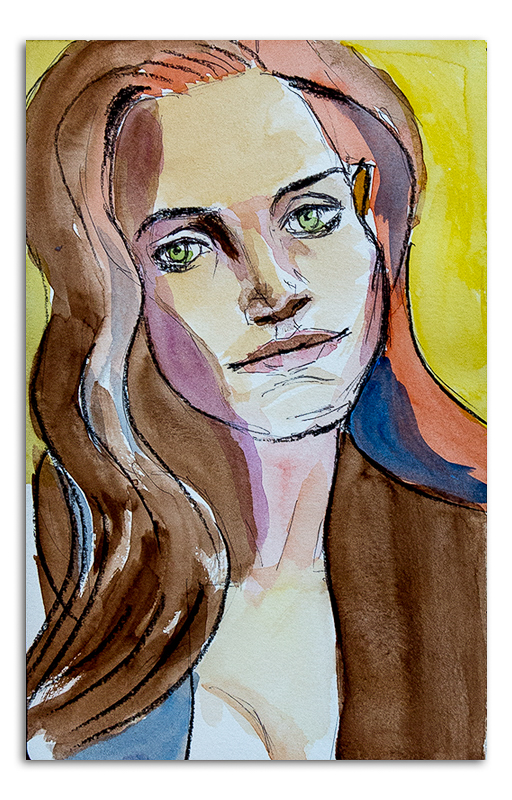
Sometimes I just go through the motions because I am just too lazy to do anything else. This watercolour is a case in point. I sketched it out in one room and painted it in another from memory because I couldn’t be arsed to get up and keep referring back to the source.
That being said I seem to be making a series of paintings about damaged women as, to me, this woman looks like she has seen far too much and that burden can be seen in her dead eyes. I wonder why that is?

 Simon's Blog